Manufacturing
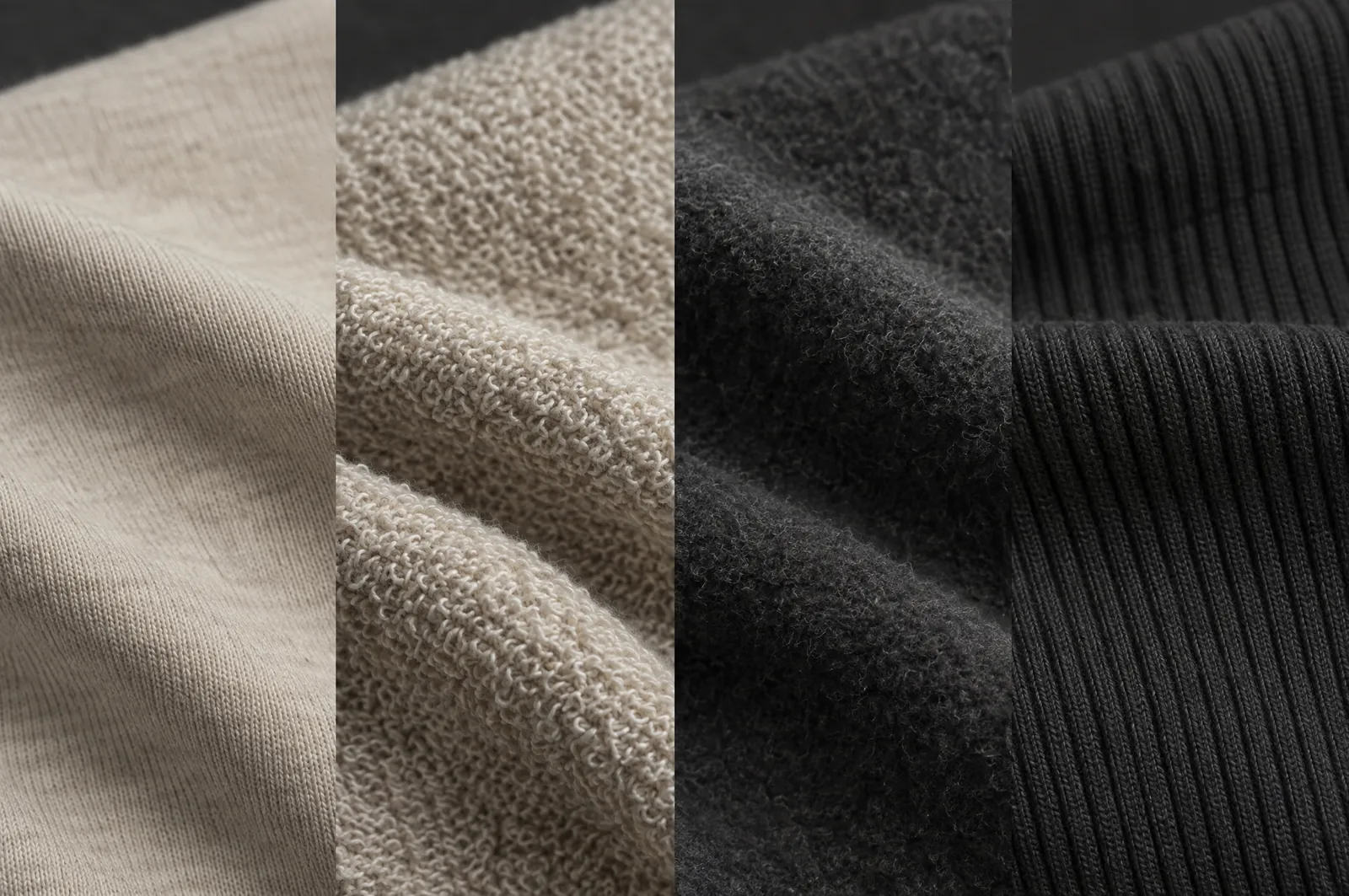
Fabrics and weights: how to choose
The fabric defines how the garment feels and which techniques suit it. Here is each one, in a sentence.
- g/m²
- Fabric weight is how much a square meter of fabric weighs.
- 33.9 g/m²
- Equals 1 oz/yd², the US measure.
- Pantone TCX
- The color guide that rules the fabric.
- Lab dip
- A dyed sample to approve color in cut and sew.
What fabric weight means.
The higher the weight, the thicker, more opaque and drapier the fabric.
| Range | g/m² | What for | Approx. equivalent |
|---|---|---|---|
| Light | under 160 | Cool, summer, budget tee | under 4.7 oz |
| Mid | 160 to 200 | Classic merch tee | 4.7 to 5.9 oz |
| Heavy | 200 to 260 | Premium, oversized, boxy tee | 5.9 to 7.7 oz |
| Extra heavy | over 260 | Heavyweight tee; sweatshirts from 280 | over 7.7 oz |
Each garment's weight is set in its tech sheet and checked when the fabric arrives.
Jersey
A single knit: smooth on the face, with small ridges on the back. It is the fabric of almost every tee.
- Typical weight
- 140 to 260 g/m².
- Garments
- Tees in every cut, tanks and long sleeves.
- Techniques
- All of them. It is the best surface for screen printing, DTG and DTF.
Combed cotton
Cotton with the short fibers removed before spinning. The yarn is more even and the fabric softer, with less fuzz. The opposite is carded cotton, cheaper and rougher.
- Typical weight
- Whatever the garment is: combed refers to the yarn, not a weight.
- Garments
- Premium tees and polos.
- Techniques
- Best results with DTG, water-based ink and fine screen-print detail.
French terry
A knit that is smooth on the face with unbrushed loops on the back. Cooler and lighter than fleece.
- Typical weight
- 260 to 350 g/m².
- Garments
- Hoodies, crewnecks, joggers and shorts.
- Techniques
- Screen printing, DTF, embroidery, appliqué and chenille.
Fleece
Like French terry, but with the inner loops brushed: they become a soft, warm pile.
- Typical weight
- 280 to 400 g/m² or more.
- Garments
- Winter hoodies, crewnecks and joggers.
- Techniques
- Screen printing, DTF, embroidery, appliqué and chenille.
Rib
A knit with vertical channels that make it very stretchy. It is named by its channels: 1×1 (fine) or 2×2 (more pronounced).
- Typical weight
- Variable.
- Garments
- Tee collars, sweatshirt cuffs and hems, fitted tanks and beanies.
- Techniques
- Little direct decoration; it is used as a garment finish.
Cotton-polyester blends
Fabrics that combine fibers. The most common: 50/50 (half and half), CVC (more cotton than polyester, for example 60/40) and tri-blend (cotton, polyester and rayon, very soft with drape). They shrink less, wrinkle less and give a heathered look.
- Garments
- Tees, sweatshirts and joggers.
- Techniques
- Screen printing with low-bleed ink and DTF. Discharge and DTG work worse the more polyester there is. Sublimation needs a polyester majority.
Polyester
A lightweight synthetic fiber that dries fast and does not shrink.
- Garments
- Sports jerseys, activewear and sublimated garments.
- Techniques
- Sublimation (the best option on light colors), DTF, low-bleed screen printing and vinyl.
Denim and woven fabrics
Woven fabrics, made on a loom rather than knitted: denim, gabardine, twill, canvas and nylon. They do not stretch like jersey.
- Garments
- Jackets, shirts, caps, totes and pants.
- Techniques
- Embroidery, chain-stitch, patches, laser engraving (denim) and screen printing on canvas.
How fabric is approved.
We choose the fabric and weight in the tech sheet.
Color is set in Pantone TCX, the textile guide. In cut and sew it is approved with a lab dip, a dyed lab sample.
We check the fabric on the floor, against Pantone and weight, before production.
Tone can vary slightly between fabric lots. That is why the reference is the approved physical sample.
FAQ
Which tee weight should I choose?
For tour merch, 170 to 200 g/m²: it holds the print well and does not feel thin. For a premium, oversized or boxy tee, 220 to 260 g/m² or more.
Tell us what you want to make.
Garments, quantities per style, the technique you have in mind and your date. With that we tell you what fits and quote firm.